Week #53 {August 16 '22}
- The Bulletin Buzz

- Aug 16, 2022
- 12 min read
Articles by Ananya Nayar, Rain Jha, Mahin Puri & Misaki Tomiyama

Articles:
Climate Bill to Make American Green
By Ananya Nayar

Last Sunday, on the 7th of August, the US Senate’s Democrats passed a $430 billion bill intended to fight climate change and reduce prescription drug prices in hope to reduce the carbon footprint and national greenhouse gas emissions.
The House votes came to 220-207, and the bill was titled the “Inflation Reduction Act'' as it can also reduce the federal deficit (national debt) simultaneously by negotiating healthcare benefits especially for the elderly and vulnerable, employing many in the green energy sectors and ensuring taxes by big corporations are being paid. It also reduces the price of prescription drugs by letting Medicare negotiate directly with pharmaceutical companies.

On the other hand, the bill will attempt to supplant the fossil fuel industry and may cut down carbon emissions by 40% in this decade. Considering the USA is the world’s second biggest source of pollution, this bill could reduce upto 15% of overall natural gas use.
Out of the $60 billion allocated for incentives for domestic manufacturing of products like technology and transportation, one-third of the amount is dedicated to sustainable farming to cut agricultural emissions. Another new implemented precaution is the imposition of a fee or fine for every ton of methane gas companies leak into the atmosphere, starting at $900 but to increase to around $1500. The bill will also increase the solar and wind energy used in industries, while nuclear plants will continue to be used at the same rate.
Although this definitely benefits the world through cleaner air, and is a huge step in curbing global warming, it’s estimated that the bill won’t be able to do much for inflation other than reduce it by less than 0.5% points annually. Economists say that in just 5 years, it won’t have a measurable role in inflation. On the bright side however, it will most definitely have a positive impact on the struggle against climate change.
FBI Raids Trump’s House in Florida
By Rain Jha

Last Monday, the FBI raided the Mar-a-Lago home of former president Donald Trump in Palm Beach, Florida, something never before done in American history. The raid was carried out under the suspicion that Trump was keeping classified documents in his residence. During the search, the FBI broke into a safe, but it is reported that no doors were broken down, and there was no conflict.
Earlier this year, in February, the FBI had also retrieved 15 boxes of White House documents from the house, and now believe that more may be hidden on the property. Trump also released a statement after, stating ‘these are dark times for our nation’, and that the situation was no different to ‘Watergate’.

Trump also took the Fifth Amendment, which simply states that he does not have to testify or speak under oath, in the case that he might be forced to incriminate himself. This also contradicts multiple statements Trump had made in the past, calling people who take the Fifth Amendment ‘the mob’.
After the incident, the FBI is yet to reveal the results of the investigation, and Trump supporters continue to spread angry exclamations of ‘Defund the FBI’. One might even draw a similarity to the liberal public, whose slogan against police brutality is ‘Defund the Police’. Trump also believes that someone in his inner circle may be ‘wearing a wire’, and the same insider leaked vital audio to the FBI which prompted them to lead the search, although this is yet to be confirmed.
Salman Rushdie Attack
Article by Mahin Puri
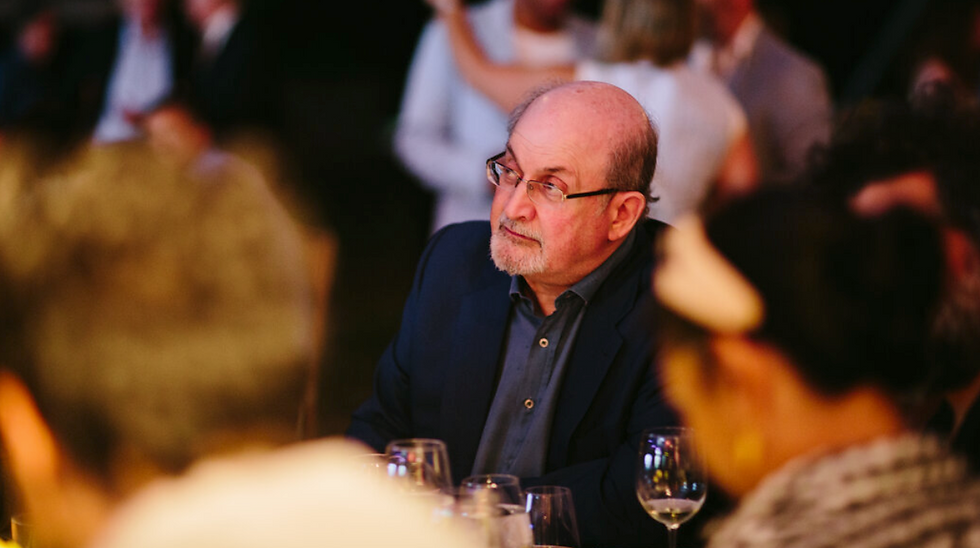
Salman Rushdie, a celebrated author of many famous, and award winning books, including the children’s book Haroun and the Sea of Stories. However after his publication of the novel ‘Satanic Verses,’ the leadership of Iran called for the author's death, yet in recent years, claiming that he has to live his life, he re-entered the norms of society and left hiding.
He was regularly seen in public, especially in New York City, even without security however recently, a threat to his life was made again, where an attacker rushed the stage of the Chautauqua Institution located on the western side of New York where the assailant stabbed Rushdie, in the abdomen and in the neck. The 75 year old author was critically injured, and many eyewitnesses mention that the injuries could have been worse had the attacker not been held back by the crowd.

The writer was taken in via helicopter to a local hospital, in Erie, where he was immediately rushed in for emergency surgery that eventually saved his life. He was in surgery for several hours and although he seemed to pull through, his agent Andrew Wylie brought about the bad news that Mr. Rushdie was unable to speak and was heavily dependent on the ventilator at the time.
Furthermore, in recent light the agent has mentioned that “Salman will likely lose one eye; the nerves in his arm were severed; and his liver was stabbed and damaged.” Which means it is not going to be very likely that anyone is going to be able to see the author anytime soon, as he is going to be kept in higher security, and also may have to go back into ‘hiding’ for a certain amount of time to prevent further events such as these, which present a threat to his life.
Russia to Leave the ISS
Article by Ananya Nayar

The International Space Station is the largest modular Space Station in orbit, and it’s an international project by NASA, ESA, CSA, Roscosmos and JAXA. Its primary purpose is to enable ‘long-term exploration’ of earth and ‘provide benefits’ to humans. It currently rotates the earth’s orbit at a low altitude of 240 miles but travels at an impressive speed of 17,500 mph, but now, it might all come to an end.
After over 20 years of a fruitful partnership with the USA, Russia plans to end it in 2024. The main reason for the withdrawal is due to the ongoing Russia-Ukraine War, as when the US imposed economic sanctions for invading Ukraine, relations between the countries became tricky.

Both countries are important contributors to the ISS, with Russia supplying certain significant parts which ensure the propulsion for the space station to remain in orbit, whilst the US powers the station through solar energy. However, both countries do also play a large part in the overall operation of the station. Earlier this year, Dmitri Rogozon, who worked at Rosmoscos, said that without Russia’s cooperation, the Space Station would plummet, as the ISS can’t function without the two nations working together. NASA’s immediate plan was to keep the ISS in orbit until 2030, but without Russia’s aid, it will be a challenge to continue to operate the space station long before that deadline. For America, this situation can be seen as an opportunity to project and build on larger NASA goals, or a roadblock to missions in space for the time being.
The Space Race, What was it?
By Misaki Tomiyama
Humans have long been interested in space; its aura of mystery, its danger, and how it may give us the answers to the questions of our existence. Space exploration and research are important to us as it helps us understand more about the world, and researching about it can save our lives in many ways.
Until now, there are approximately 565 astronauts who have traveled to space, but only 65 of them being women. Coming from 40 various countries, these astronauts have risked their lives on their journey to space. Currently, there are 15 International space agencies that are able to launch independently.

The Space race was a competition about 70 years ago, to see which country, between the United States and the Soviet Union, was more superior in terms of spaceflight, and which of the two could make it to space first.
After WW2, a conflict known as the Cold War began. This resulted from the tension between the two superpowers; Capitalist America and Communist Soviet Union, who each feared that the other was out to conquer the world.
In 1995, both countries announced that they would launch satellites into orbit. The race itself started in 1957 when the Soviet Union launched Sputnik, the world's first artificial satellite. The U.S. was afraid of this - they thought that if the Soviet Union could launch satellites, they might be able to launch nuclear missiles too. However, the U.S. launched their first satellite, Explorer 1, four months later.

In April 1961, cosmonaut Yuri Gagarin became the first man to go to space and orbit the earth. The Americans launched their Freedom 7 three weeks later, making Alan Shepard the first American to go into space.
(Fun fact- Cosmonauts are people trained by the Russian Space Agency to work in space. Astronauts are people trained and certified by NASA, ESA etc, to work in space. Astronauts are a term Americans used, while cosmonauts refer to only Russian space travellers)
The U.S.A’s worries of not winning the space race grew, and on May 25th, 1961, US President John F. Kennedy made a claim that America would first land a man on the moon and would do it before the end of the decade. Then, the Apollo program was launched. After that, there were several feats by the two nations: In February 1962, John Glenn became the first American to orbit Earth, and in June the following year, cosmonaut Valentina Tereshkova became the first woman to travel to space. America became even more determined to be the first to launch a man on the moon, and NASA increased its budget to achieve their goal. The Americans launched another program, called the Gemini program, that allowed Ed White to become the first American to perform a spacewalk, after Alexei Leonov from the Soviet performed a 12 minute and 9 seconds spacewalk a few months before.

On July 20th, 1969, The Eagle landed on the moon's surface, and Neil Armstrong became the first man to walk on the moon. America had won the space race, by the 70s, the relations between the two nations improved. The two then jointly sent 3 astronauts into space in the Apollo-Soyuz mission.

In 1998, construction began on the first International Space Station, the largest man-made object in space, 357ft long and 240ft high. It is still the most expensive object ever built, its price ranging around $150 billion.
A large amount of money was used by the two nations during the space race, and it is considered to be hugely significant as it drastically improved technology of both nations. Earth is one small dot compared to space. Many answers to abundant unknown scientific questions- innovation in mankind, new technologies and colonisation- lie in space, and it is immensely important for humanity to continue its research.
Why Do We… Have Mucus?
By Ananya Nayar
Mucus, as gross as it may be, is a lubricant and protective, sticky substance secreted in your mouth, nose, intestines, lungs, stomach and even your throat. It’s important in making sure these passages don’t dry out, and it’s also full of bacteria, antibodies, and proteins that can fight germs and prevent them from entering the body. It follows a filter, trap, and elimination process to remove microparticles.
This gelatinous substance is produced by mucous membranes that are mostly in the respiratory system from the nose to the lungs. They play an important role in removing allergens, viruses and dust from the respiratory tracts. The body naturally produces around a huge 1-1.5 litres of mucus on a daily basis, but there is only a problem when an excess is noticed.
Person of the week: Who was Rakesh Jhunjhunwala?.
Article by Mahin Puri

Rakesh Jhunjhunwala was a billionaire investor who was known to have a ‘Midas touch’, which suggests that everything he touched turned to gold. A pioneer, and big bull of the Indian stock market, he was often referred to by many as the Indian Warren Buffet, and someone who critically and effectively studied the stock market to eventually produce tremendous profits for himself and those at his firm, RARE enterprises. He was a phenomenal trader and also spent some time as a chartered accountant.
According to the Forbes rich list, he was ranked as the 36th richest man in India, thanks to his many profitable investments. He was also chairman of two companies, Hungama media, and Aptech, and was also part of many important firms’ board of directors, such as Viceroy Hotels, Concord Biotech, Provogue India etc.
He developed an interest in the stock market after overhearing his father and some colleagues discuss not with friends, and eventually was allowed by his father to dabble in the market, however without financial aid from his father who also further forbade him from asking his friends for money. Yet, he still prevailed, and borrowing from his brother's clients, he promised to return the capital provided with even higher returns compared with bank fixed deposits, and wasn’t wrong as he brought in major earnings very soon.
He earned his first major profit in the year of 1986 when he bought 5,000 shares of the Tata Tea company at 43 rupees and the stock rose to 143 rupees, thus tripling his profits within three months, meaning that in less than 3 years, he had earned 20-25 million rupees.
Over the years, the business magnate successfully invested in Titan, CRISIL, Sesa Goa, Praj Industries, Aurobindo Pharma, and NCC, which led to his growth in terms of personal wealth, eventually leaving it sitting at 5.8 billion dollars.
‘Attack On Titan’ Anime Review
By Misaki Tomiyama

You can’t call yourself an anime watcher without watching Attack on Titan, the darkest, and bleakest of all animes you’ll find out there. With a worldview that has never been seen before, the sense of hopelessness that this anime brings about - the mysteries, foreshadowing, and music - Attack on Titan is an anime I simply can’t say enough about.
Attack on Titan is set in a post-apocalyptic world, where Titans have threatened the existence of humanity and ruled mankind. Ever since then, humans have been living in the fear of these giant creatures, in cities surrounded by walls. Just as things are starting to look up for the citizens of Shiganshina, a ‘Colossal Titan’ appears, shattering the peace, along with the very walls that had been protecting the citizens for more than 100 years. Attack on Titan explores the dreams of a young boy, Eren Yeager, as he begins his long battle of desperation after vowing to exterminate the Titans who have killed his loved ones.

In order to fulfill his promise, Eren Yeager, along with his childhood best friends Mikasa Ackerman and Armin Alert, enlist in the ‘Survey Corps,’ a military branch closely involved in Titan combat. There is incredibly deep character development in this anime, and every single character introduced is a key part of the plot. Although these characters are developed and portrayed well, the complete story behind them is never revealed, which is the key to Attack on Titan’s fascinating and gripping storyline. Along with a soundtrack that draws you in and creates the air of melancholy throughout the series, and the fantastic visuals this anime entails, Attack On Titan is a must-watch. As you watch the four seasons (still ongoing), you can also see the development in the artistic features of the anime, which makes it even more interesting. Although there are a couple of filler episodes in the series, it doesn't take away much from the flow, but rather gives you a break from the dark setting.

Because of the large amount of new information that enters every episode, Attack on Titan can become a bit difficult to understand, especially after the third season. So, it’s probably a good idea to read a summary online after finishing a season, or a couple of episodes. Quick disclaimer coming your way! Attack on Titan is an anime full of graphic and bloody violence, where humans tend to be eaten by Titans in horrific ways, so if you’re not a huge fan of gore, it’s probably not a good idea to spend your time on this anime.
Overall, Attack on Titan is definitely a masterpiece that will go down in anime history. The flow of the anime is amazing, and the characters are not only relatable but develop through the seasons, especially the protagonist Eren Yeager, whose shoulders are heavy with the deadly sin of human genocide in order to protect his loved ones. It’s the perfect anime to watch when you’re feeling a bit too happy, and honestly, I’d do anything to watch Attack on Titan again for the first time.
‘The Hound of Rowan’ Book Review
By Rain Jha

This book, the first of a five-part series, has striking parallels to the Harry Potter fantasy books. But Henry H Neff’s writing style is very different from that of J K Rowling. For one, this is set in the modern era of technology — devices appear in the story, a fresh take on the magical world. And of course, the humor is more to my liking.
The main storyline goes like this: The protagonist, Max McDaniels, a 12-year-old boy living in Chicago is sent an invitation by a school of magic, Rowan Academy. Here he meets his roommate David Menlo who is very gifted at Mystics (magic) but is reluctant to share his past. The antagonists are Astaroth, a demon imprisoned in a painting, and his followers who try to set him free.
Neff’s imagery and descriptions are very evocative. For example, when he describes a ki-rin, a black lioness. “Bigger than a rhino and crowned with a single broken horn of speckled ivory, she stepped heavily out onto the porch…her black fur gave off a faint, white shimmer…her eyes were clouded with milky cataracts…”
However, the book is relatively flat for the usual kind of beginning hook, as it includes a lot of worldbuilding — the plot could have been stronger — but I would recommend that you read through it quickly and move on to the next book in the series where the story is much richer. The sequels, on the other hand, do carry this book series to another level, and I highly recommend any readers who enjoy fantasy, adventure, and action to try it out.


Comments