Week #41 {18 October '21}
- The Bulletin Buzz

- Oct 18, 2021
- 9 min read
Good Morning Readers! Here is your weekly news summary, we hope you have a great week :)
Articles Written By Ananya Nayar and Misaki Tomiyama

Order of articles-
Kids Articles-
Other Articles-
India & China’s Energy Crisis
Article by Ananya Nayar

Just as Southeast Asian countries India and China were approaching an endemic, an energy crisis, unseen for 50 years emerged and it turns out that this could become a bigger issue than the pandemic.
Coal prices and gas prices are at the highest they’ve ever been and in India, stocks of coal in power plants have fallen dangerously low so the electricity product is scarce. In fact, 80% of the plants are in a supercritical stage where stocks may run out within simply a week, here, there is an impending power crisis and warnings of blackouts are being issued. In some areas, such as Rajasthan and Bihar, there have been scheduled power cuts to ensure less consumption.

China, on the other hand, is facing the worst power crisis in over ten years, and are seeing coal rationing, measured power outages and unprecedented blackouts.
This issue wasn’t expected so soon by many, but as coal fails to supply us with energy, it seems that there are urgent government measures required. Coal, being a non-renewable source (it can be depleted fast and not replenished at the same pace at which it’s being consumed) is no longer reliable at all. The growing populations, increasing demand, higher economic activity, monsoon-related supply destruction are probably the primary factors as of now.

Having said that, is this a wake-up call? As non-renewable energy sources are practically exhausted, the situation in China and India should accelerate incentives around the world to convert to renewable energy sources (such as solar power, wind energy) as soon as possible.
Yet for places like India for example, who’s already on the brink of this climax, the governments are simply resorting to extra coal-mining as a short term solution and doubling down on renewable energy pledges. They encourage the use of renewable energy sources and are looking to assemble those, but in the long term, a translation from coal to renewable sources is extremely necessary.
Sudan Protests- What’s Happening? + About the Government
Article by Misaki Tomiyama

Protests have been going on in Sudan recently, and thousands of protestors gathered near the Presidential Palace in Khartoum last week on Saturday. Before talking about why they were protests, let’s understand a bit about the political background of Sudan.

For around two years, Sudan, located in Northeast Africa, has been experiencing a political crisis, after president Omar al-Bashir was overthrown in 2019. The Sudan government established as a result of this, was a part-military and part-civilian government. This new government has been facing difficulty in showing its citizens that they are capable of reforming the country by positively stimulating their economy, and transitioning their country into a democracy.
While the government was trying its best to make situations better, the COVID-19 pandemic hit hard and negatively impacted the country’s economy. This resulted in a rise in unemployment and poverty rates and deteriorating public health. Not only this, but the country has also been struggling with diplomacy and domestic issues including floods and locusts.

As a result of the low living standards of citizens, there were several protests that have been occurring in the country since last year, demanding for a better quality of life. Well, the protests that happened last week were slightly different from this though. The demonstrators on the streets were pro-military who opposed Sudan’s transition to democracy. These protestors demanded, and voiced their opinion that the military should take over the country.
Denuclearisation: World Leaders Can Blow Up the Planet
Article by Ananya Nayar

Nuclear bombs are explosive devices that obtain their force from internal nuclear reactions, they release huge amounts of energy, although they are small in size and are extremely destructive.

A brief science behind them: Nuclear bombs are weapons that ‘harness’ the forces that hold the nucleus in the atom together, or stabilise the nucleus by releasing energy when neutrons or protons merge/split. Did you know that the heat of a nuclear explosion can reach millions of degrees Celcius? The sudden explosion will kill all life immediately and is known to ‘vaporise’ human tissue. Even shelters cannot save most here, and even if you do (rarely) survive a nuclear bomb’s explosion, the Gamma rays produced are cancerous and could affect you several years later.
If you couldn’t tell, nuclear weapons are extremely harmful and cause severe damage to the environment. So severe it’s incomparable.

The biggest nuclear explosion in history was the Tsar Bomba. It was created by the Soviet Union last century, as part of a race with the United States. The Tsar Bomba was a hydrogen bomb that was capable of 100 Mt, but that plan was avoided since it had more potential for radioactive fallout.
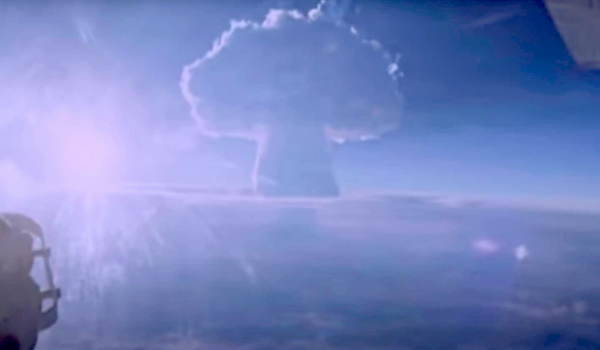
Instead, they settled for a ‘smaller’ one, technically not very small at all. The mushroom cloud produced as a result of the reaction was 25 miles wide at the base and 60 at the top. It penetrated the stratosphere and rose 40 miles high. Everything in the radius was immediately vaporised and extreme damage extended to 150 miles radius, which could potentially extinguish a large city or a small country.
Of course, the experiment was done in ‘safe’ conditions, if safe is unpopulated regions by humans, but the catastrophic bomb annihilated all marine life.
1 Tsar Bomba could potentially destroy a billion lives and could make a billion starve. To completely destroy earth to smithereens, a few thousand could cover it. To remove all life, scientists approximated around 30 Tsar bombs could do this.
So, if the effects of nuclear weapons are so dangerous and deadly, why do they exist? We only have one planet, and it’s self-destructive to have so many bombs in power. Recently, the Treaty on the Prohibition of Nuclear Weapons introduced itself and by October 2020, 50 countries had signed the pact. On the 22nd of January 2021, nuclear weapons became illegal. However, it still doesn’t mean that they’re not there and it may be a matter of time before one is used again.
The Lucy Mission to Trojan Asteroids
By Misaki Tomiyama

NASA recently sent out their newest probe into space for a 12-year mission. Lucy, being the name of the asteroid probe, is expected to study the ‘Trojans’ which are the clusters of asteroids revolving around Jupiter. The Trojans are said to be the ‘leftovers’ from the formation of the planets in our solar system.

Through the mission, NASA wants to learn more about Jupiter, and how it was formed. On its journey, Lucy will revolve around the Earth twice, then fly for Jupiter. It will use 6 years to search the solar system and studying it, to learn more about the evolution of the system.
Coldplay’s Eco-Friendly Tour
Article by Ananya Nayar

You may have heard of the band Coldplay, you may have not. Anyway, Coldplay is a rock band that’s been playing for almost 25 years, in 2019 they decided to stop doing tours and concerts after issues concerning the environment until they found a solution to cut their emissions. Now, four years later the band announced they are back and will be starting a full World Tour in 2022. However, this tour has something never seen before- sustainability in the wildest form!

Chris Martin announced that the upcoming tour will be partly powered by their fans, who will jump on the dance floor. As they have fun and jump in the concerts, the dance floor will simultaneously generate electricity to power the band’s pedal power. It sounds incredibly innovative to have an eco-friendly focus!

The ‘Music of the Spheres’ tour will cut direct emissions by 50%, compared to the tour in 2016-2017. Along with this, for every ticket purchased, a tree will be planted, which does justice to their environmental pledge in 2019.
The band told BBC that they “don’t mind backlash at all. (They’re) trying (their) best and (they) haven’t got it perfect… and the people that give us backlash for that kind of thing, for flying (on private jets,) they’re right.” In their pledge, the band partnered with BMW to develop a rechargeable show battery, entirely powered by recycled cooking oil, kinetic energy and solar power.
This new tour is certainly exciting, and could potentially be a turning point for the live entertainment industry!
Why is Our Sea Salty?
By Misaki Tomiyama

If you’ve ever been to a beach, you have probably (accidentally) tasted the ocean water and realised that it’s salty. Well, in this article, we will explain why the oceans are salty!
The salt in the waters are caused by rain, and it washing mineral ions from rocks into the oceans. Rainwater is slightly acidic as carbon dioxide is dissolved into it. When it begins to rain, it hits the rocks and weathers it, and this is called weathering. Weathering is a process in which rocks are broken down into smaller bits. During the process, mineral salts are released and are separated into ions. This is then carried by water bodies such as rivers and eventually sent to the oceans, making the ocean salty.

The oceans, approximately have a salinity of approximately 3.5%. This means that for every litre (1000 ml) of the seawater, there are 35 grams of salts dissolved in it.
This Week in History
Article by Ananya Nayar

On October 11th 1971, Kathryn D. Sullivan, American geologist and former NASA astronaut became the first woman to complete a spacewalk.

In 1492, on the 12th of October, Christopher Columbus set foot on the ‘new world’ after 2 months at sea with the Pinta, Santa Clara and Santa María. This piece of land is actually the Bahamas now.

Did you know when the first spiral galaxy was discovered? Well, Charles Messier- a French astronomer discovered the Whirlpool Galaxy or Messier 51a on the 13th October 1773. Spiral galaxies typically have stars, gasses and cosmic dust orbiting a central bulge, thought to be a black hole.

Our favourite movies came from... Disney right? Well, on the 16th of October 1923, the Walt Disney Company was officially founded by Walt and Roy. At the time, it was the Disney Brothers Cartoon Studio and it’s interesting to see how much the company has evolved in almost a century!
Did You Know? October 17 is the International Day For the Eradication of Poverty.
By Misaki Tomiyama

Every year, on the 17th of October, the world celebrates International Day for the eradication of poverty. On this day, we aim to come together to understand the struggle of people living in poverty and try to help those in need.

The main idea that is to be spread on this day is that the poor are the first to fight against poverty, as they experience first-hand challenges. Take India for example, approximately 68.8% of the Indian population lives on less than $2 a day, and millions don’t have basic necessities including food and shelter. Approximately 1 billion children in the world live in poverty, and 22000 children die as a result of this every single day in the world.
Here are a few things you can do to help.
Volunteer in an organisation/initiative which aims to help the poor.
Give donations! Here are a few websites you can donate to help with the situations around the world. (Unicef, WFP and UNHCR)
Spread Awareness about the poverty situation in different parts of the world. (Use the hashtag #EradicatePovertyDay when posting on social media!)
Give your old clothes to children who need them.
Book & Movie Reviews
Reviewed by Ananya Nayar
Book of the Week: The Firework Maker’s Daughter by Philip Pullman

The Firework Maker’s Daughter is a beautiful novel, and I could picture everything in this scenic story so well. It’s something fresh with childhood and innocence strung in it, so I’d recommend this for a change from other books.
The story is set perhaps centuries ago and a thousand miles away and follows young Lila and a firework-maker called Lalchand. Lila grew up learning about fireworks, but there’s one big secret about it he dares to unveil. One day, Lila becomes more and more curious, and won’t be discouraged, so with the help of her friend Chulak, she determines the great, scary adventure all firework makers have to endure to get where they are. They must face the Fire Fiend of Mt. Merapi and bring some Royal Sulphur, but that’s not all. On the way, she coincides with pirates, spirits and demons, not like they’ll stop her though…
Overall, I thought this was really sweet and although it’s a children’s book, it’s so mature that I’d recommend it to anybody.
Age Recommendation: 7+
Rating out of 5 Stars: 5/5
Movie of the Week: Queen of Katwe

This movie is by far one of the best I’ve ever seen. It touches upon sexism, colourism, poverty and just has so many inspiring qualities.
It follows Phiona, a pretty, intelligent young girl living in a camp in Kampala, Uganda. She starts as a ten-year-old, working with her mother every day. Her family faces many issues, there are financial issues and other setbacks as well. One day, she stumbles upon a chess class, led by Robert Katende. She’s fascinated and intrigued, and although she is first discriminated against for being poorer than the rest of the students, she proves her worth by quickly becoming the best in the class. Later, she is introduced to local competitions, which she aces, but then come bigger ones. Tournaments that could be her key to freedom, an escape from the poverty in Kampala. Will it really be though? She has a bright future here, what can she do?
I was captivated by this, first, the characters and casting were perfect! The actors played the roles seemingly effortlessly and magically. I loved how each person had their own story too, although the focus was really on Phiona, I was rooting for all the characters by the end of the film. There are so many authentic emotions and the film had so much originality. I’d recommend this for family nights too!
Age Recommendation: 7+
Rating out of 5 Stars: 5/5


Comments