Week #30 Articles {July 19 '21}
- The Bulletin Buzz

- Jul 19, 2021
- 11 min read
Articles by Ananya Nayar and Misaki Tomiyama

Articles-
Kids' Corner-
Other Articles-
Articles
What's Happening in Cuba?
Article by Ananya Nayar

Last Sunday (11th July) Cuba saw the biggest protests in their country in over thirty years. Thousands of citizens demonstrated through Havana, Palma Soriano and San Antonio de Los Baños to show that things had to change and they were not going to go hungry or be mistreated any longer. The thousands are fighting for food and medicine which were supposed to be guaranteed.

Cuba thrives on tourism, however, the pandemic has not allowed tourists to come and therefore Cuba hasn’t made much money off travels in the past year and a half. This issue along with the pandemic as a whole causes the country to face an economic crisis.
What’s more is that after the U.S. broke trading with Cuba, there was no financing or imports. After the Trump administration tightened sanctions, the economy dipped even further!
(To learn more about the ongoing economic sanction is the U.S. sanction to Cuba, visit Week #26 articles!)
Only 15% of the population are vaccinated, 30,000+ active cases, food prices have soared 300%, the peso has devalued 2300%.

The inflation rates are incredibly dangerous. Beans used to cost 10-12 Cuban pesos but are not costing 20-25 pesos. Mangoes that used to cost only 5 pesos are now 15. The same portion of rice costs 20 pesos now, instead of just 5.
In healthcare there isn’t enough oxygen for patients who require it, ambulances are out of reach, beds aren’t attainable etc and this is what is fueling the death rate.

Much of the population lived in poverty even before the pandemic, during it, those poverty rates increased and the inflation rates are leading to death and starvation.
There have been hundreds of deaths due to COVID in the past year and citizens are not receiving much aid or medicine due to the economic situation and because the government is not providing any humanitarian aid.
Threatened by the mass protests arising, the government has arrested many demonstrators, and have used tear gas to disperse crowds. Many, many people have been reported missing since the protests began (and all of them were those who were protesting their rights.)
For over sixty years, Cuba has lived repressed. People have been surveilled, beaten, publicly humiliated, fined, restricted to travel to many areas, often in Cuba itself. To summarise- little freedom and freedom of speech.
There have been 61 years of authoritarian dictatorship, famine, pandemic, less freedom of speech and no voting rights.
To help you can follow Cuban activists, read on the hashtag #soscuba, support and donate to Cuban citizens, sign petitions like ( Petition · U.S MILITARY INTERVENTION IN CUBA - INTERVENTION MILITAR ESTADOUNIDENSE EN CUBA · Change.org,) ( Here are some ways Miamians can help the people in Cuba )
Tokyo Olympics- What Do People Think About It?
Article By Misaki Tomiyama

With the Tokyo Olympics and Paralympics 2020 just around the corner, concerns arise in whether they should be held. Some are against it and say lives are more important than hosting a sports event and walking across the streets of Tokyo, I often see people holding a sign, and protesting for the cancellation of the event.

With cases on the rise, the government has declared a state of emergency for Tokyo for the fourth time, from July 12 to August 22. Many other prefectures, like Chiba, Kanagawa and Saitama, which are prefectures surrounding Tokyo, have taken priority measures for the prevention of the spread of the virus, as their cases are higher compared to that of other prefectures. In areas with a declared state of emergency, there are strict regulations on the opening hours of restaurants and fast-food chains, controls on the flow of people, active test strategies and so on.
The Tokyo Olympics and Paralympics are taking place from 23 July to 5 September (Olympics from 23 July to 8 August, and Paralympics from 24 August and 5 September), and during this time, Tokyo will be under a state of emergency. It has been declared that the Olympics will be held without spectators.

Although government officials have repeatedly announced that precautions to ensure the safety of citizens will be tightened, many citizens are afraid hosting the event will put many at risk. A poll conducted in May (by Asahi Shimbun) has shown that over 80% of citizens want the Olympics cancelled or postponed. Many Japanese athletes also expressed their voices on whether the Olympics should be held, or not. Tennis world champion, Osaka Naomi, mentioned in a BBC interview, 'If people are not feeling safe, then it's a really big cause for concern.' Meanwhile, the IOC (International Olympic Committee) reiterates that the games can go ahead safely.
The Normalisation of Ableist Behaviour
Article by Ananya Nayar
“We are a society that treats people with disabilities with condescension and pity, not dignity and respect.”
- Stella Young

Ableism is a form of discrimination that has been undeniably normalised in our society. It’s in favour of more able-bodied people and a lack of understanding of the experiences that lesser-abled people face. For example, ableism is rooted in a pity or different treatment of people with disabilities- like assuming they are unhappy with themselves, assuming they always require aid and cannot learn, study or grow to be a doctor, astronaut or anything that more-abled people do. Ableism tends to define people by their disabilities and considers them inferior.
In your everyday life, you may see people be ableist and ignore it because it’s extremely normalised. Some may think that disabled people are a leech on the system, or are incapable of speaking for themselves etc.
Common ableist language is words like, “midget,” “r*tarded, ``''blind, ``''deaf, ``''imbecile, ' “nuts,” “psycho,” and “spaz.” These terms may be easily associated with a person's identity or their challenges, and because of that, can be interpreted as insulting or hurtful.

The question is- why is ableist behaviour so normalised today? Firstly, the behaviour promotes the privilege of able-bodied individuals. It devalues the disabled experience and suggests that disabled individuals are less entitled to their rights.
Systemic ableism includes the physical barriers or regulations made by the law that often exclude those with disabilities from equal participation and opportunity. For example, lack of accommodations- where there may be five flights of stairs but no elevator. In turn, this doesn’t allow people with disabilities in their legs etc to be able to reach places on the levels above them.
Internalised ableism is where the practices that favour able-bodied people are or have been ingrained or implied through society’s ways or schooling. For example- working with somebody with slight disabilities is often viewed as ‘charity work’ rather than out of your heart or will.
We cannot ignore discrimination of any kind- and it isn’t a minor problem. About 1 billion people worldwide – 15% of the global population – have some type of documented disability. In the US, this proportion is even larger, at about one in four people, and in the rest of the world, it’s similar.
Kids' Corner
What is the Tour de France?
Article by Ananya Nayar
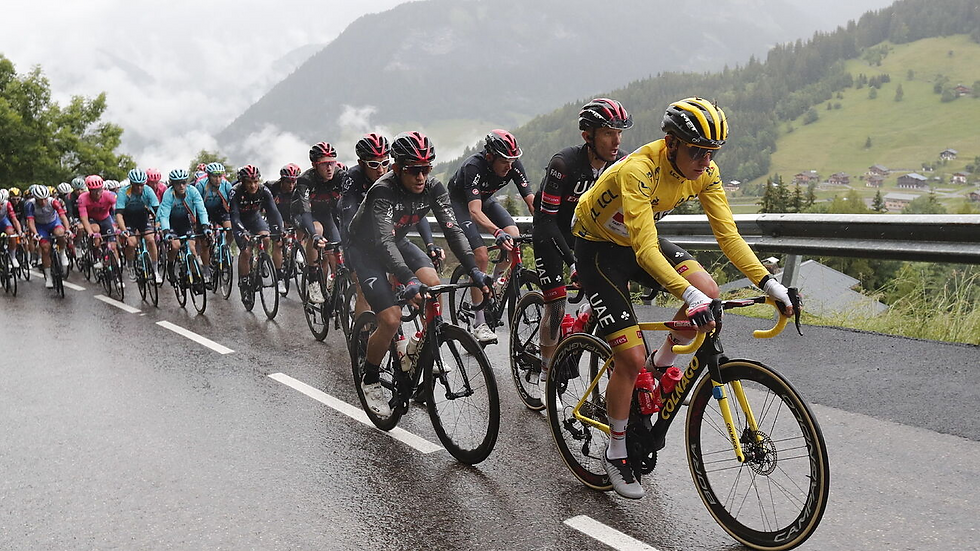
The Tour de France is a yearly men’s bicycle race held in France, although it passes through nearby countries as well. It has 21 stages in total and is held over 23 long days- like other Grand Tours. The nickname for the Tour de France is ‘La Grande Boucle,’ which translates into "big loop," and refers to the route taken around France.
Due to the Olympics being postponed last year due to the pandemic, this year's Tour de France was made to shift a week earlier to prevent date overlapping.
The Tour de France is the world’s most prestigious cycling event, and it attracts the most international cyclists. It’s the most difficult race out of the three races (others are Giro d’Italia and the Vuelta an España.)

The first Tour de France was in 1903. The plan was a five-stage race from 31 May to 5 July, starting in Paris and stopping in Lyon, Marseille, Bordeaux, and Nantes before returning to Paris. Toulouse was added later to break the long haul across southern France from the Mediterranean to the Atlantic. The race was first founded for publicity- and to improve the circulation of L’Auto (a French sports newspaper of the time.) Henri Desgrange planned it out and the first version was a six-stage race with a distance of 2428 kilometres.
How Are Clouds Formed?
Article By Misaki Tomiyama

When you look at the sky on a bright, sunny day, you see clouds. White, fluffy looking clouds in the sky. Have you ever wondered what they are made out of, and how they are formed?
In simple words, clouds are formed when the water vapour in the sky, which is an invisible gas, becomes water droplets. These water droplets form on tiny particles in the sky, which float on air.
When you dry your clothes, you put them under the sun. After a while, they are dry. This is because the water on the clothes has evaporated. When water evaporates, it changes into water vapour as gas and floats into the atmosphere. The same happens in oceans, rivers, ponds and other water bodies (or even from the ground). The water changes into water vapour due to evaporation, and this happens when these water molecules on the surface of the water body, gain energy from the sun, or any other heat source, and escape the water as gas.

When the water evaporates, it rises into the atmosphere at first as steam, and it slowly becomes cold. When it cools, it becomes tiny droplets of water. In this process, the water vapour collides and sticks with tiny particles in the sky which are floating in the air. These droplets are what makeup clouds.

We see clouds in the sky, but what if this process takes place near the ground. Well, clouds can form on the ground level as well, and this is called fog. If you have touched fog or walked through it, you have touched and walked through a cloud!
Other Articles
This Week in History
By Ananya Nayar

The famous Ancient Egyptian Rosetta Stone was found on July 19th 1799. A French soldier discovered the black basalt rock with ancient writing inscribed on it near the town Rosetta. The stone is irregularly shaped and contains passages written in hieroglyphics of Greece and Egypt. It was allegedly inscribed by priests in the second century BCE. The Rosetta stone holds the key to solving hieroglyphics- a written, complicated language that hadn’t been used in 20 centuries. Hieroglyphics are small characters- like small pictures and the stone helps us understand them.

On the 20th of July 1969, Neil Armstrong walked the moon. 240,000 miles from Earth, the American astronaut spoke these words to more than a billion people listening at home: “That’s one small step for man, one giant leap for mankind.” Stepping off the lunar landing module Eagle, Armstrong became the first human to walk on the surface of the moon.

On July 21st, 1944, Adolf Hitler announced that the attempt on his life had failed and that “accounts will be settled.” Hitler had survived the bomb blast that was meant to take his life. He had suffered punctured eardrums, some burns and minor wounds, but nothing that would keep him from regaining control of the government and finding the assassins.

On the same date, but in 2007, the seventh and final Harry Potter book- Harry Potter and the Deathly Hallows was released. 12 million copies were initially printed in the US itself.

On July 24, 1911, American archaeologist Hiram Bingham discovered the famous ruins of Machu Picchu, an ancient Inca settlement in Peru that has become a well-visited tourist destination. Machu Picchu is supposedly a summer retreat for the Ancient Inca leaders after the Spanish took their civilisation in the 16th century. In the early 19th century Bingham arrived with his team of explorers to search for the lost cities of Incas.
This Day Signifies- Did You Know? July 18 is Nelson Mandela International Day!
Article By Misaki Tomiyama

Every year on the 18th of July, the world celebrates Nelson Mandela International Day. Also known as the father of modern South Africa, Nelson Mandela was a social rights activist, who was the first black president of South Africa. During his time, the government of South Africa was oppressive, and he peacefully fought against it for many years. He negotiated with South African President F.W de Klerk in the early 1990s, to discuss and end South Africa’s apartheid system- a former racial segregation policy that discriminated the non-white in South Africa. Along with the efforts of F.W. de Klerk, they successfully ended the apartheid system and brought multiracial democracy. Nelson Mandela and de Klerk were awarded the Nobel Peace Prize in 1993 for doing so.

The idea of this international day is that each individual can change the world and impact society. Everyone can make a change, and a few days to celebrate this day are-
Spread your ideas and awareness about Nelson Mandela International Day. You can use the hashtags #MandelaDay and #ActionAgainstPoverty to show your support.
Volunteer. Just like how Nelson Mandela loved helping others, you can do so too! Volunteering can be anything from helping an animal shelter, a non-profit organisation, at your local library, and if you find doing so difficult for any reason, you may even just help your family or friend!
Educate yourself and others. You can read up more about the history of South Africa, and learn more about Nelson Mandela, F.W. de Klerk, Nobel Peace Prize and more! (Some reliable websites are hyperlinked if you would like to learn more!)
Book and Movie Reviews
Reviewed by Ananya Nayar
Luca (a Disney movie)
Spoilers included!

This charming, animated children’s movie follows Luca- a sea monster boy who lives with his family under the water. He’s made to do his duties and is restless because he wants to explore the ocean and go beyond where he is. He’s always told he’s not allowed to go to the surface (aka land) but that just makes him more curious. One day, he goes to the surface and befriends Alberto (another creature like him) who teaches Luca all about life on land and how to adapt to his new, human body. They are crafty, and build Vespas (a brand of Italian motorbikes) and begin to form the dream of buying and riding a Real Vespa.
After being threatened to be banished to the deep sea by his parents, Luca decides to stay on the surface and win a race so he and Alberto can get a real Vespa. With the help of their new friend Gulia, they attempt to win the race against a bully and their ability. You see, the sea monsters transform back as soon as they touch the water- and that’s a huge restriction especially if you want to live as a human in secret on an island. They must be careful because Sea monsters like themselves are being hunted for large rewards! So, can they win the race and protect their identities or not?
I loved this movie because the friendship is sweet and pure, it’s just about two boys having realistic dreams and wanting to fit in! It was heartfelt and meaningful.
However, there were some resemblances to the children's 11 movies the ‘Little Mermaid’ that are uncanny and too similar for coincidence. Some of the parts of the movie were vague and could’ve been defined more for audience interest- for example, what his family do throughout the movie was unexplained and lots of little pieces like Luca’s different lives were not documented or not documented enough.
Age Recommendation- 7+
Rating out of 5 Stars- 3.5/5
‘One Last Stop’ by Casey McQuiston

This book is about Jane and August, two friends who meet each other on a subway in New York and eventually fall in love. The books are not about their relationship though- although that’s included of course. It’s about how Jane realises she’s lost and has been lost for the past 45 years as she sat on the Q train, connected and not ageing a day through a large electrical power surge. August must help Jane learn about her past as a runaway and find a way to save her before the train shuts down once and for all.
The storyline was romantic and is anything but cliche, I would never have expected half the things that happened in Jane’s previous life.
The story is told from August’s perspective and the largest question in the story and our minds is ‘How do we fight to keep someone with us when their existence is outside the rules of the space-time continuum?’
It’s cute and sweet but some parts are certainly not appropriate for younger readers.
What I didn’t like too much was the fact that we couldn’t hear from Jane and see everything from her view. For example, it would’ve been interesting to see how she felt like a lesbian living in a world 50 years later, where the world is more inclusive.


Comments